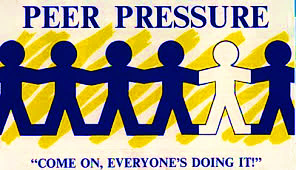
Peer pressure is the actual or perceived pressure which an individual may feel, to conform to what he believes that his peers or colleagues expect.
Peer pressure thus falls within the area of conformity.
Conformity is the tendency to allow one’s opinions, attitudes, actions and even perceptions to be affected by prevailing opinions, attitudes, actions and perceptions.
Peer pressure is the pressure we feel to do what our group or peers expect of us.
Solomon Asch carried out several experiments investigating the nature of conformity, in which he asked people to judge which of lines A, B & C was the same length as Target Line.
In this picture, C is the same length as the Target Line.
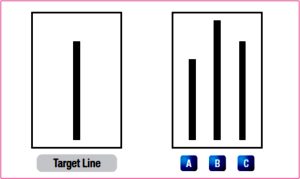
He asked this question under different conditions:
- The individual was asked to make the judgment on their own.
- The individual carried out the task after a group of 7–9 others had all stated that line A was the correct choice.
The result:
- In the first condition, very few mistakes were made (as would be expected of such a simple task with an obvious answer).
- In the latter condition, on average, participants gave wrong answers on one third of the trials by agreeing with the confederate majority.
Clearly, participants yielded to group pressure and agreed with the incorrect ‘group’ finding
However, it is worth mentioning that there were considerable individual differences: some participants never conformed, and some conformed all the time.
Peer pressure is closely linked to organizational norms and culture.
As with organizational culture, peer pressure or conformity can work either for, or against safety.
- An organization with a positive safety culture, for example, will exert pressure on newcomers to operate with a professional and positive attitude.
- However, an organization in which shortcuts and non compliance are commonplace will have a negative influence on the behavior of individuals.
The degree to which an individual’s view is likely to be affected by conformity or peer pressure, depends on many factors, including:
- culture (people from country x tend to conform more than those from country y);
- gender (men tend to conform less than women);
- self-esteem (a person with low self-esteem is likely to conform more);
- familiarity of the individual with the subject matter (a person is more likely to conform to the majority view if he feels that he knows less about the subject matter than they do);
- the expertise of the group members (if the individual respects the group or perceives them to be very knowledgeable he will be more likely to conform to their views);
- the relationship between the individual and group members (conformity increases if the individual knows the other members of the group, i.e. it is a group of peers).